
§ 1The Premises Liability Act replaces ordinary negligence
When someone is hurt on property in Colorado because of the condition of the property, or because of activities or circumstances there, the claim against the landowner runs through C.R.S. 13-21-115. The Colorado Supreme Court has read the statute as the exclusive remedy against a landowner in those situations. In practical terms, a claimant cannot simply plead general negligence against the owner and ask the jury whether the owner acted reasonably. The statute decides what the owner owed, and that depends on why the visitor was there.
StatuteC.R.S. 13-21-115 Enacted in 1986 and amended several times since, partly in response to court decisions applying it.
The legislature's stated aim was to make landowner duties more predictable than they had been under case-by-case negligence rules. The trade-off is that the label attached to a visitor can matter as much as the hazard itself. Two people can slip on the same icy step and have very different claims.
§ 2Three categories of visitor, three levels of duty
| Visitor | Who fits | What the landowner owes |
|---|---|---|
| Invitee | Customers and others there for business of mutual interest, or because the owner held the property open to the public. | Reasonable care to protect against dangers the owner actually knew about or should have known about. |
| Licensee | People there with permission for their own purposes, including social guests. | Reasonable care about dangers the owner created and actually knew of; a warning about dangers the owner did not create, that are not ordinarily present, and that the owner actually knew of. |
| Trespasser | Anyone who enters or stays without consent. | Liability only for damage the owner caused willfully or deliberately. |
Notice the knowledge language. For an invitee, constructive knowledge counts: if a reasonable inspection would have revealed the danger, the owner is treated as knowing about it. For a licensee, the statute says "actually knew," which is a much harder thing to prove. That difference is the reason so many premises cases turn on the visitor's status before anyone looks at the hazard.
A customer who wanders into a marked employees-only storeroom may stop being an invitee for that part of the visit. Courts look at the purpose and scope of the invitation, not only the reason someone first walked in.
§ 3Which category fits your visit?
This quick check matches a reason for being on the property to the statutory category it most often falls into. Real cases can be closer calls.
Visitor category check
C.R.S. 13-21-115(5)General information only. A lawyer will look at the full facts, including whether your status changed during the visit.
§ 4Who counts as the landowner
The Act's definition of "landowner" is broader than the name on the deed. It includes an authorized agent or a person in possession of the property, and a person legally responsible for the condition of the property or the activities conducted on it. Depending on the facts, that can reach a tenant, a property management company, or a contractor who controls a work area.
This matters for two reasons. First, the right defendant is whoever controlled the spot where the injury happened, and a commercial lease may split that control between landlord and tenant. Second, a defendant who is not a landowner under the Act may face an ordinary negligence claim instead, which is a different standard. Lawyers often start by requesting the lease and any maintenance or snow removal contract.
The snow removal contractor
A shopping center hires a contractor to plow and de-ice. A customer falls on an icy patch near the door. Is the contractor a "landowner" because it was responsible for the condition of the walkway? Courts have reached different answers depending on how much control the contract gave the contractor. The practical lesson: get the contract, because the duty question may turn on its exact wording.
§ 5Ice, snow and the realities of a Colorado winter
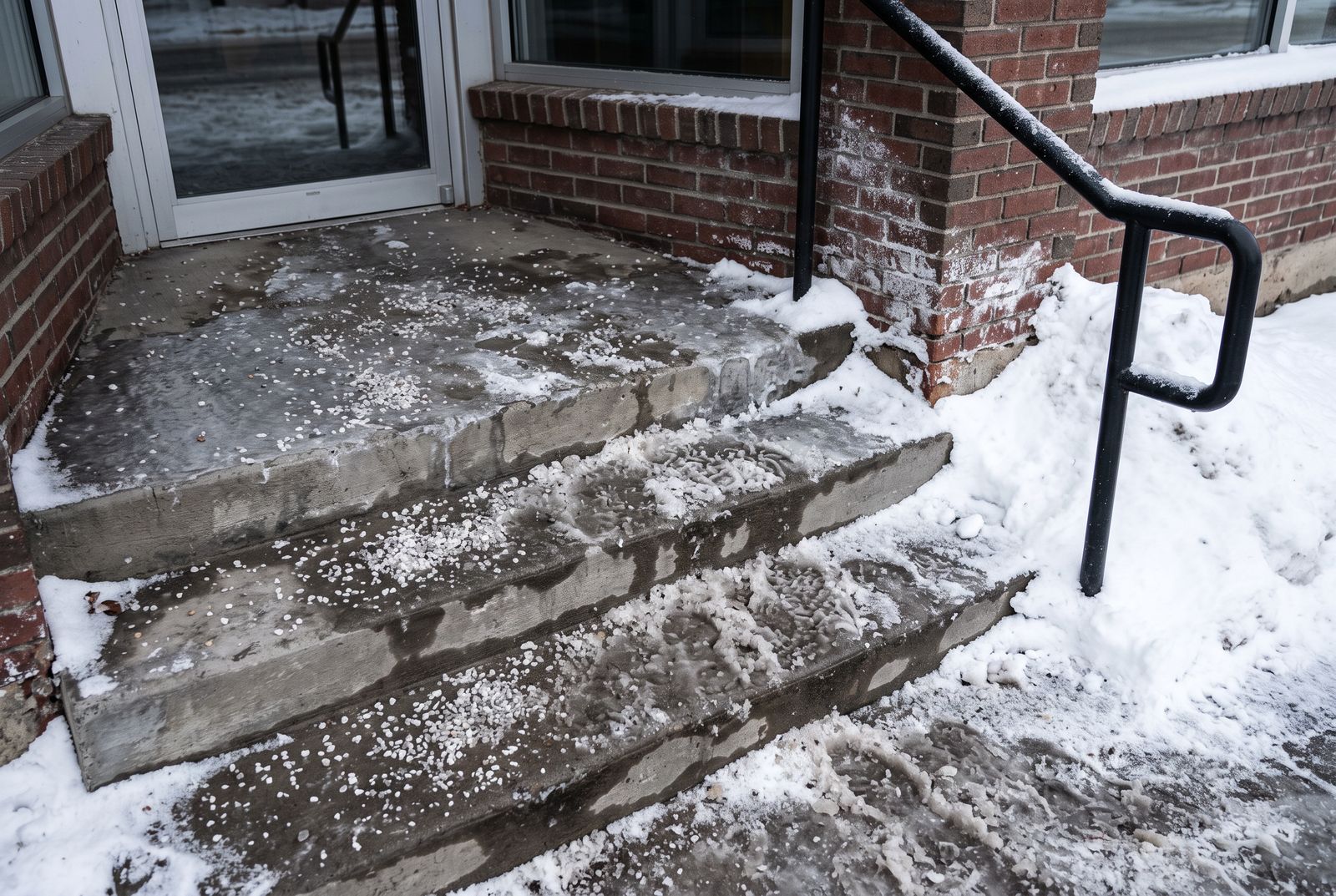
Freeze-thaw cycles are part of life along the Front Range. Snow melts on a sunny afternoon, runs across a walkway and refreezes after dark. Shaded north-facing entries can hold ice for days after the street is dry. These patterns make ice falls one of the most common premises claims in the state, and they shape what "reasonable care" looks like for an invitee.
Questions that tend to matter in an ice case:
- When did the snow stop, and how much time passed before the fall?
- Did the owner have a written snow and ice plan, and was it followed that day?
- Was the ice caused by the property itself, such as a downspout draining across a walkway?
- Were there mats, salt, handrails or warning signs, and where?
- What was the claimant wearing and looking at, which feeds the comparative fault number?
Many Colorado cities have ordinances requiring owners to clear adjacent public sidewalks within a set time. Whether breaking such an ordinance creates civil liability to a pedestrian is a separate legal question from whether it brings a city fine, so do not assume one follows from the other.
§ 6Public property, recreation land and ski areas
Public entities
Falls in a courthouse, library, school or other public building fall under the Colorado Governmental Immunity Act. Immunity is waived for a dangerous condition of a public building under C.R.S. 24-10-106(1)(c), among other waivers, but the claimant must serve a written notice of claim within 182 days after discovering the injury (C.R.S. 24-10-109). The Act also limits how much can be recovered. See the Colorado filing deadlines for how these periods interact.
Recreational use
Colorado encourages landowners to open land to the public for recreation. Under C.R.S. 33-41-101 and following sections, an owner who allows recreational use without charging for it generally is not liable for injuries except in cases such as willful or malicious failure to guard or warn against a dangerous condition. Charging a fee usually removes that protection.
Ski areas
The Ski Safety Act, C.R.S. 33-44-101 and following, sets its own rules: skiers accept the inherent dangers and risks of skiing as the statute defines them, and ski area operators have specific duties about signage and closures. A ski injury claim is its own specialty.
The bottom line
Identify the visitor category first, then the landowner, then the hazard. An invitee with evidence the owner should have known about the danger has the strongest position. A licensee needs proof of actual knowledge. A trespasser needs willful or deliberate conduct. Public property adds a 182-day notice.
For how fault is split once a duty and breach are shown, see the Colorado comparative negligence section.
Colorado premises liability questions
Is a social guest an invitee or a licensee in Colorado?
A social guest is a licensee under the Premises Liability Act. The statute defines a licensee as someone who enters with the landowner's permission for the visitor's own convenience or interests, and it says expressly that the term includes a social guest. That means the owner's duty is narrower than the duty owed to a customer.
Can I sue a landlord for a fall at my apartment?
Possibly. The Act defines "landowner" broadly enough to include people in possession of the property and people legally responsible for its condition, so a landlord, a tenant, or a property manager can each qualify depending on who controlled the area where the fall happened. Common areas such as stairways and parking lots are often under the landlord's control.
Does the store have to know about the spill?
For an invitee, the store is liable for dangers it actually knew about or should have known about. "Should have known" is where many cases turn: how long the spill was there, how often staff inspected the aisle, and whether the store created the hazard itself.
What if I fell on public property?
Claims against a city, county, school district or other public entity run through the Colorado Governmental Immunity Act. Immunity is waived for some dangerous conditions, including public buildings under C.R.S. 24-10-106(1)(c), but a written notice of claim is due within 182 days after discovering the injury. Missing it usually ends the claim.
Does comparative fault apply to slip and fall cases?
Yes. Colorado applies its comparative fault statute, C.R.S. 13-21-111, to premises claims. Footwear, attention, lighting you chose to walk through, and warning signs you passed all feed into the percentage.
No questions match that filter.
Last reviewed November 2026. Colorado statutes are amended often. Check the current Colorado Revised Statutes, or ask a licensed Colorado attorney, before relying on any figure or deadline here.